Cyclic Voltammetry (CV)
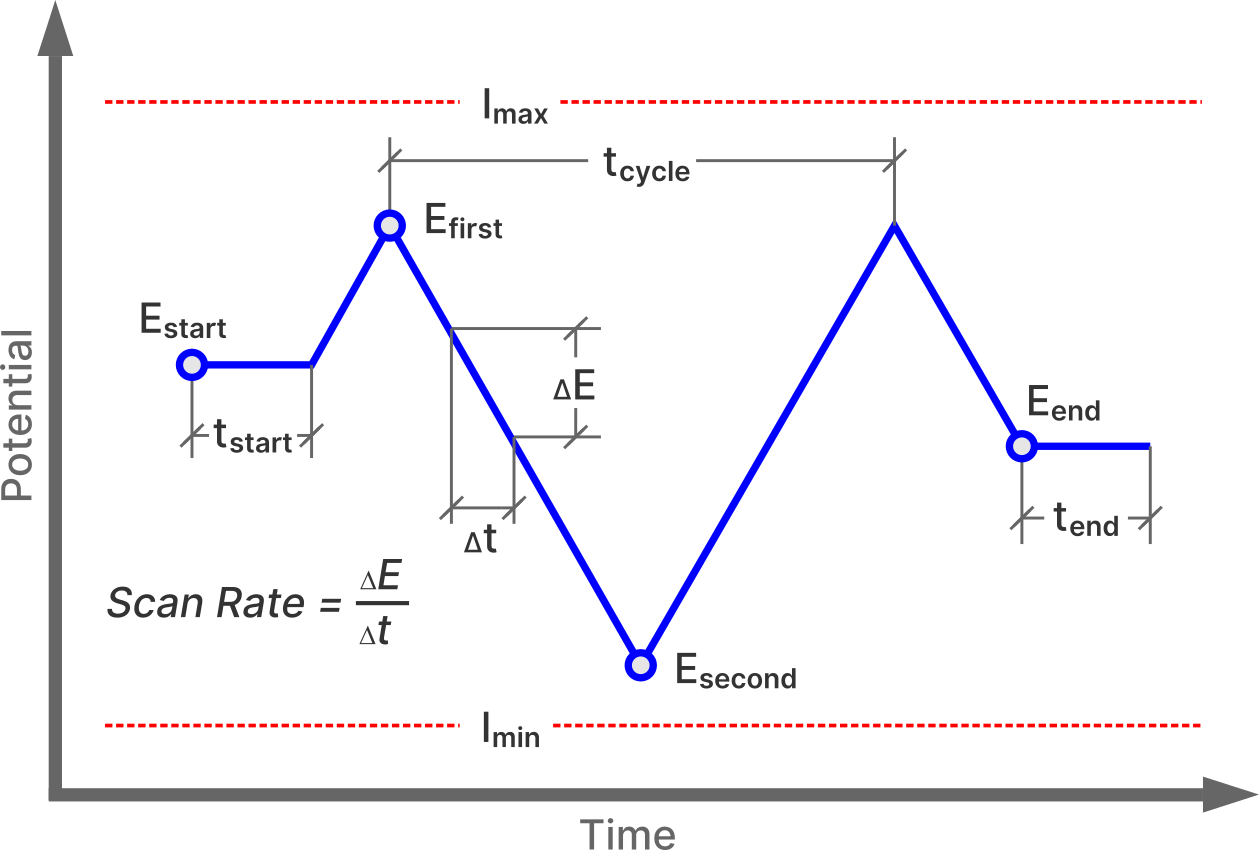
Cyclic Voltammetry operates under potentiostatic control, applying linear voltage ramps at a constant scan rate between defined potential limits with periodic direction reversal. Each complete cycle sweeps from an initial potential to a switching potential and returns to the starting point, creating the characteristic triangular waveform. Multiple cycles can be performed sequentially to observe electrochemical processes over time.
Precise control of experimental conditions ensures reproducible and reliable results. Both potential values and time intervals for initialization and termination phases can be independently configured. When the start phase is enabled, all four CV potentials can be referenced to the open circuit voltage (OCV) for consistent baseline measurements.
Two independent current limits can be set for the measurement: a positive (maximum) and a negative (minimum) limit. If the current exceeds one of these limits during the scan, the scan direction is automatically reversed. This reversal occurs immediately, even if the vertex potential has not yet been reached. This mechanism protects the sample and the instrumentation from damage caused by high currents.
Maintaining scan rate precision is critical for successful CV measurements and accurate kinetic analysis. The electrochemical workstation must prioritize continuous potential sweeping without interruptions from auto-ranging or other instrumental adjustments. Fixed current ranges, predetermined by the user based on expected signal levels, ensure uninterrupted data acquisition.
Optional iR drop compensation corrects for ohmic losses caused by solution resistance between reference and working electrodes. This compensation is particularly important in resistive media, where uncompensated resistance can lead to apparent shifts in peak potentials and distorted voltammetric features.
Parameter Description
Parameter |
Name |
Description |
Unit |
|---|---|---|---|
E start |
starting potential |
starting potential |
V |
E first |
1st vertex potential |
first reversing potential |
V |
E second |
2nd vertex potential |
second reversing potential |
V |
E end |
ending potential |
ending potential |
V |
Scan Rate |
\(\frac{∆E}{∆t}\) |
voltage scan rate for ramping between potentials |
\(\frac{V}{s}\) |
N cycle |
cycles |
number of full CV cycles (scan from 1st potential to 2nd potential and back to the 1st potential) |
|
ODR |
output data rate |
output data rate can be set directly in points per second or according to a defined voltage resolution |
\(\frac{1}{s}\) |
I range |
current range (abs) |
optional fixed current range selection if autoranging is disabled |
A |
I min |
minimum current |
minimum current limit for the premature reversal of the potential scan |
A |
I max |
maximum current |
maximum current limit for the premature reversal of the potential scan |
A |
t start |
start duration |
runtime at starting potential |
s |
t end |
end duration |
runtime at ending potential |
s |
A Start Phase Potentiostatic can be enabled or disabled before the method is executed.
Note
Zahner Lab automatically calculates the number of data points per CV cycle based on the measurement settings to provide an accurate estimate of data point density. This calculation cannot be performed when absolute and relative potentials are mixed in the same experiment.
Measurement Result
Cyclic voltammograms provide comprehensive electrochemical characterization of the system under investigation. Direct analysis of the current-potential curves reveals key parameters including peak currents, peak potentials, and peak shapes, which reflect the thermodynamics and kinetics of redox processes.
Quantitative analysis enables determination of fundamental electrochemical properties such as formal potentials, diffusion coefficients, and heterogeneous electron transfer rate constants. These parameters provide deep insights into reaction mechanisms and mass transport phenomena.

Custom Experiment Builder
This experiment is a combination of the following blocks: